
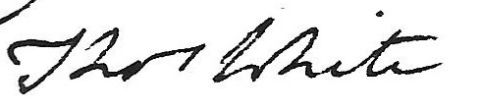
The landscape designer, Thomas White (c. 1736-1811), had a long career during which he worked at over 90 sites across northern England and Scotland, providing improvement plans and often carrying out their implementation. He was usually engaged at multiple sites and needed to liaise with owners, estate stewards (or factors in Scotland), nurserymen who supplied the shrubs and trees and his foremen responsible for supervising the work. While he was often on the road visiting in person, this was not always possible and so he relied on the only form of communication available at the time – letters.
Just over 50 letters or short notes sent by him have been identified and they give a fascinating insight into his work and career. They start in c. 1762 when he was employed by Lancelot ‘Capability’ Brown and end with two sent in 1807 a few years before his death, when he had retired and passed the business onto his son, Thomas junior. Many, as would be expected, are sent to clients giving advice and an update on progress. However the series of letters he sent Lord Stormont about the works at Scone Palace between April 1784 and September 1786 showed his obvious frustration. He felt he was being blamed for the poor work done by Stormont’s men and his Lordship’s desire to keep costs to a minimum saying:
‘Thirty pounds my Lord will go but a very little way in our mode of improving grounds, and I must acquaint you that the contingent expenses, exclusive of labour, has already lost me a much Iarger sum’ (c. late June 1784, Scone Palace Archives 667/19i)
In his final letter on 25 September 1786 (Scone Palace Archives 1233/27), he clearly shows his annoyance about the way he had been treated:
‘I hope my Lord I am not naturally wanting in respect to my superiors and in particular to my employers, but my Lord I am no vassal and thought self very improperly treated at Scone. I have however reason to thank your Lordship that business that has given me more pain than pleasure is to have an end.’
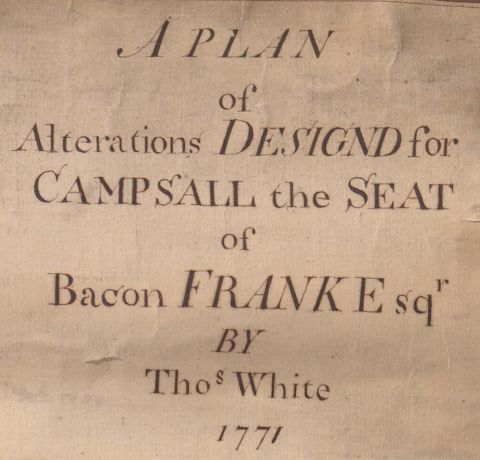
One of the most important relationships he had were with his foremen. They were vital to ensure that his plans were implemented correctly, on budget and on time to satisfy his clients. Many worked with White for a long time and clearly a good deal of trust was built up between them. There are letters to his foreman, William Stones, from January 1767 to May 1768 when White was engaged in laying out the grounds at Newby Hall for William Weddell and at Copgrove Hall for Thomas Duncombe. Stones had been working at the nearby Goldsborough Hall for the designer Richard Woods from June 1764. So when White took over the commission there in early 1766, he continued to employ Stones as the foreman and then transferred him to Newby.
The main issue between Stones and White, not surprisingly, is money. White had only just started out in his career and cashflow was probably tight. He was expected to fund both the wages of his foreman and often the labourers as well. However he did not always get the money upfront from his clients, as they were sometimes slow payers. Any perceived waste or indeed fraud was thus a particular source of irritation as he reminds Stones:
‘I am much surprised that you should employ a boy to help (Tomson) do nothing and charge him in your bills. I am likewise surprised you should charge me with 11s you say you (paid) Gray on my (account) which I know to be false and did not know that I was to be answerable for your bad debts’ (January 22 1767, West Yorkshire Archives Services Leeds WYL100/EA/23a/38)
‘I am informed that great abuses has been made In the hay be letting the horses eat round the stacks when they please, which for the future I desire may be better managed and hope there will be no room left for further complaint of that kind.’ (May 17 1767, West Yorkshire Archives Services Leeds WYL100/EA/23a/44)
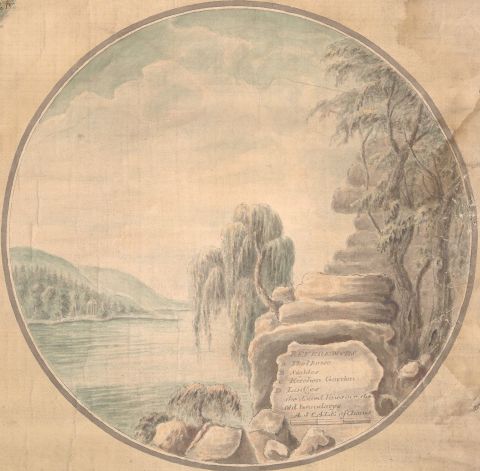
While most letters were sent from his home, Tickhill and then Retford, some were written during his visits to sites and this has helped add to our knowledge of his commissions. His son, Thomas White junior, started working with him in the 1780s and helped with the administrative side of the business as three of the letters are sent by him on behalf of his father. One, dated May 26 1789, is to a client, the Earl of Findlater, informing him of plans being sent. The other two are to the Society for the Encouragement of Arts, Manufactures and Commerce in late 1796, giving details of the extensive tree planting undertaken by his father at Taxal on the Cheshire/Derbyshire border. The Society awarded medals for tree planting and Thomas White had already received many awards for his plantations.
Sadly it appears that letters he received have not be found to date. There are also probably many more buried in archives, so I would be interested to know of others out there.
To see a listing of the letters, see Thomas White letters index
The full text can be found here.